
What is a Personal Asthma Action Plan and how is it helpful?
A Personalised Asthma Action Plan (PAAP) is a written plan issued by a healthcare professional, designed to help individuals manage their asthma effectively. They are recommended for all people with asthma including children, young people and adults. Even people who have previously been stable may develop worsening symptoms. The PAAP typically sets out clear written instructions on daily asthma management, such as the use of inhalers and other medications, and details on how to recognise and respond to worsening symptoms or an acute asthma episode or ‘attack’. A PAAP is associated with fewer exacerbations and fewer hospital admissions.
A PAAP is associated with fewer exacerbations and fewer hospital admissions.
The plan helps you recognize patterns such as increased frequency or severity of symptoms like coughing, wheezing, shortness of breath, or chest tightness. For young people and adults who track their peak flow measurements regularly, the plan can reveal declining lung function before asthma symptoms become obvious.
Asthma action plans are typically divided into three zones: Green, Yellow, and Red. The Green Zone indicates stable asthma, where the patient feels well, and any peak flow readings measured are within the normal range. The Yellow Zone suggests caution as symptoms might be worsening and prompts medication or lifestyle adjustments. The Red Zone signifies a medical emergency, requiring immediate action and emergency medical attention.

My daily asthma routine
I need to take my preventer inhaler every day, even when I feel well.
I take puff(s) in the morning.
I take puff(s)at night.
My preventer inhaler (insert name and colour):
My reliever inhaler (insert name and colour): I take my reliever inhaler only if I need to.
Other medicines and devices I use for my asthma every day (for example, spacer, peak flow meter):
My asthma is being managed well when:
• I follow my daily routine and I have no symptoms
• my personal best peak flow is:
If I’ve not had any symptoms or needed my reliever inhaler for at least 12 weeks, I can ask my healthcare professional to review my medicines, in case they can reduce the dose.
When I feel worse
My asthma is getting worse if I have any of these:
• I have symptoms like wheeze, tightness in my chest, feeling breathless or a cough
• I’m waking up at night with symptoms
• my symptoms are interfering with my daily activities, like work or physical activity
• I’m using my reliever inhaler 3 times a week or more
• my peak flow drops to below:
URGENT! If you need your reliever inhaler more than every 4 hours, you need to take emergency action now. See section 3.
What I can do to manage my asthma now
If I have not been using my preventer inhaler,
I’ll start using it regularly again.
If I have been using it, I will:
• increase my preventer inhaler dose to puffs times a day until my
symptoms have gone and my peak flow is back to my personal best
• take my reliever inhaler as needed, up to puffs every 4 hours
• carry my reliever inhaler with me when I’m out (with a spacer if I use one).
URGENT! See a doctor or nurse within 24 hours if your symptoms get worse, or if you’re still having symptoms after 7 days.
Other advice from my healthcare professional about what to do if my asthma is worse:
In an asthma attack
I’m having an asthma attack if I’m having any of these:
• my reliever inhaler is not helping or it’s not lasting 4 hours at a time
• I find it difficult to walk or talk
• I find it difficult to breathe
• I’m wheezing a lot, or I have a very tight chest, or I’m coughing a lot
• my peak flow is below:
What to do in an asthma attack
1. Sit up and try to keep calm.
2. Take 1 puff of your blue reliever inhaler every 30 to 60 seconds, up to 10 puffs.
3. If you feel worse at any point or you do not feel better after 10 puffs, call 999 for an ambulance. If you do not have your blue
reliever inhaler, call 999 straight away.
4. If the ambulance has not arrived after 10 minutes and your symptoms are not improving, repeat step 2.
5. If your symptoms are not better after repeating step 2, and the ambulance has still not arrived, contact 999 again immediately.
IMPORTANT: If you have a MART or AIR inhaler, please tell the responder when you call 999.
After an asthma attack
• If you managed your asthma attack at home, contact your GP surgery or 111 today.
• If you were treated in hospital, see a healthcare professional within 48 hours of being discharged.
• Finish any medicines prescribed, even if you start to feel better. If you do not improve with treatment, see a healthcare professional urgently.
Implementing a PAAP involves regular monitoring of symptoms, taking asthma medications (such as inhalers) as prescribed, and understanding triggers for asthma symptoms. It includes signs which suggest that an individual’s asthma may be not under optimal control, such as night-time waking, exercise limitation, a persistent cough or needing to use a reliever inhaler more than three times per week. It provides clear action steps, such as when to use a reliever inhaler, when to increase preventer medication, and when to seek medical advice. Regular scheduled reviews within a hospital or GP asthma clinic are an important part of the plan, ensuring that an individual is assessed regularly and that their asthma treatments are adjusted as needed. Most GP practices will offer an annual asthma review around the date of an individual’s birthday. This proactive approach helps prevent emergencies and maintains better overall asthma control.
A good PAAP usually includes:
- How to recognise worsening asthma
- When and how to use reliever medication
- Clear advice on when to seek urgent medical help
An example of a National PAAP (from Asthma + Lung UK) can be found at: www.asthmaandlung.org.uk/healthcare-professionals/adult-asthma/AAPs
What should be included in a PAAP for children or young people?
Plans should always be age-appropriate and shared with parents, carers, and schools. When followed closely, they improve school attendance and increase a child’s participation in activities. A PAAP is especially important for children as it helps the adults around the child to respond quickly and consistently when asthma symptoms change. Younger children may not always recognise or be able to explain their symptoms clearly, so the plan acts as a set of clear, shared instructions for multiple caregivers.
A PAAP also helps children and young people over time to recognise and manage their own asthma symptoms. Younger children learn by watching adults follow the plan, and as they grow older, they can be taught the meaning of the green, amber and red zones and when they should ask for help.
PAAPs for children may be more visual than those for adults and may not always include peak flow measurements. There are also Action plans for Viral-Induced Wheeze, mostly affecting pre-school children, which are very similar to those for asthma.
Medicines and Personalised Asthma Action Plans
A PAAP is important in ensuring that individuals with asthma take the correct medication at the correct time. For example, many people with asthma use their blue Salbutamol reliever inhaler more often than is helpful. They take a couple of puffs to relieve their asthma symptoms, and if symptoms do not respond quickly they may keep taking more. If they are not using the correct preventer medications they may ‘over-use’ their blue inhaler, which can be dangerous. Using more than three blue inhalers in a year is linked with higher rates of severe asthma attacks, hospitalisation and even with deaths from asthma. This can affect people with mild or moderate asthma.
Frequent use of a blue inhaler can mask worsening asthma and can reduce the effectiveness of this medication. If a person with asthma needs to use their blue inhaler more than three times a week, this indicates that their asthma is unstable. Needing to use a reliever inhaler that often is a sign that the inflammation in the lungs isn’t being treated, and that that person is at higher risk of an asthma attack.
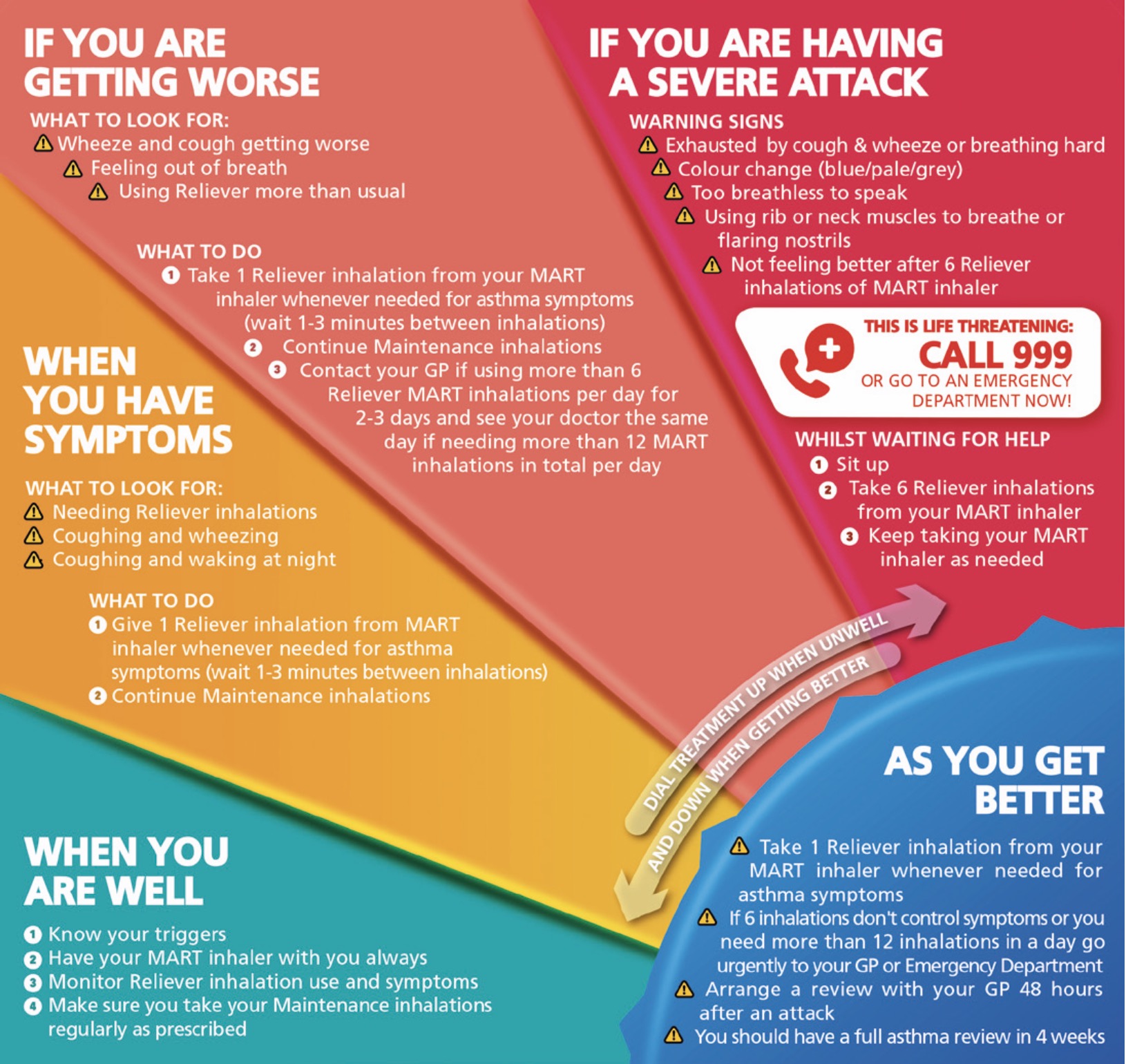
What is the Maintenance and Reliever (MART) regimen?
Moving across to the newer ‘maintenance and reliever’ (MART) regimen can help reduce the use of blue reliever medication and consequently improve asthma control as it is impossible to not give the preventer medication. A MART inhaler is one which can be used as both a preventer and a reliever. Every time a dose of the inhaler is taken as a reliever, it an extra dose of steroid is also delivered and this treats the underlying inflammation in the airways. MART inhalers have been proven to reduce asthma attacks and unscheduled care visits.
MART Asthma Action Plans should also include clear instructions including the number of extra puffs which can be taken for worsening symptoms, the maximum daily dose and advice on when to seek emergency help.
The example of a MART asthma action plan to the left can be found at: https://remedy.bnssg.icb.nhs.uk/media/5i1buscf/fa-teen-asthma-plan-nhs-bristol-26aug2023
Periods of transition
Consistency is crucial during transitions, where new triggers or stressors might arise, potentially affecting asthma control. This applies to taking on new employment, travel and a number of other situations. In children’s services, transition specifically refers to a planned process that supports young people as they move from children’s to adult services, usually between the ages of 16 and 18. Key elements of good transition include:
- Encouraging young people to understand their asthma and medications
- Helping young people learn how to be responsible for ordering their own repeat medications
- Gradually increasing independence in self-management
- Reviewing and updating the PAAP in a developmentally appropriate way
- Clear communication between paediatric and adult teams
For young patients moving to adult care, a PAAP fosters independence and self-management skills, as it empowers them to understand and manage their condition without relying entirely on parental supervision. Having a clear action plan can also help individuals communicate their needs to teachers, out of school activities or employers, ensuring they receive appropriate support.
For young patients moving to adult care, a PAAP fosters independence and self-management skills, as it empowers them to understand and manage their condition without relying entirely on parental supervision.
A PAAP is especially important during transition, as this is a time when the taking of regular asthma medications can become more erratic, and the risk of poor control may increase.
When is a hospital referral needed?
If an individual’s asthma does not respond to their management plan, a primary care asthma clinic will consider a referral to a hospital consultant. This is typically necessary when asthma becomes more severe or increasingly difficult to control with standard treatment methods. A specialist in a hospital setting can offer more specialised testing, advanced treatment options, and will offer a thorough evaluation.
Reasons for referral:
- Poor asthma control despite medium or high-dose inhaled medications
- Frequent acute asthma episodes
- Severe or life-threatening asthma attacks
- The need for repeated courses of oral steroids
- An unclear diagnosis or suspected alternative conditions
- Persistent symptoms despite taking all prescribed medications regularly
- Consideration of advanced therapies such as biologics
Other indicators for referral might include the need for additional diagnostic procedures, such as allergy testing or lung function tests, to better understand an individual’s asthma triggers and severity. If there is a suspicion that other underlying conditions may be complicating asthma, or if an individual is experiencing side-effects from their current medications then specialist input might be necessary.
Regular collaboration with a hospital clinic can ensure that an individual’s asthma management is as effective as possible, providing access to the latest treatments and interventions. It is essential that people with asthma, or their parents and carers, communicate openly with their GP or asthma nurse to determine if and when a referral is the best course of action.
Key messages
- Every person with asthma should have a Personalised Asthma Action Plan
- Worsening symptoms require prompt action and are not something to ‘just live with’
- Seeking help early for acute symptoms can prevent severe attacks
- Transition from children’s to adult care should be planned and supportive.
- A referral to a hospital asthma clinic is appropriate when asthma remains difficult to control
- If you are unsure about your asthma control or your PAAP, book an asthma review: this is an important step in keeping well
Resources
You can find many examples of PAAPs online. National plans from Asthma + Lung UK have been translated into 12 languages. Beat Asthma is a resource for the management of children with asthma.
All health advice resources – Asthma + Lung UK
Home – Beat Asthma

Dr Deborah Marriage
Consultant nurse for allergy and asthma at the Bristol Royal Hospital for Children
Deb Marriage is Consultant nurse for allergy and asthma at Bristol Royal Hospital for Children where she has worked since 2002. She previously worked in allergy at St Mary’s Hospital, London. Deb has completed the MSc in Allergy at Southampton University and a Professional Doctorate in Health at the University of Bath.
Deb is involved in local training programmes for GPs and practice nurses and has recently been involved in setting up a new model of community-based asthma care. She is an advocate for nurse-led services and in promoting the extended role of nurses. She enjoys research and her particular interests are in asthma, health inequalities, in egg and peanut allergy and in looking at alternative ways of delivering healthcare.